Every homeowner on the Central Florida Gulf Coast knows that keeping a house insured has become a major challenge. Between rising rates and changing policy rules, insurance costs have soared across our region over the last few years. While you can’t control the weather or the insurance markets, you aren’t completely helpless when it comes to lowering your monthly bills. Taking proactive steps to strengthen your home against tropical storms can dramatically cut your ongoing expenses.
The most effective way to lower your premiums is to invest in specific wind-mitigation roof upgrades when it is time for a roof repair or full replacement. Insurance companies in Florida are required by law to offer credits for homes that feature proven, storm-resistant construction details. By updating hidden components like your underlayment and structural fasteners, you can make your home much safer while securing a substantial roof insurance discount in North Port.
At Leggett Roofing, we are a family-owned local business that builds roofs to handle the toughest Florida climates. With over 15 years of industry experience, our team knows exactly what local building inspectors and insurance adjusters look for on a wind mitigation report. We do what we say we’ll do, helping families across Sarasota, Port Charlotte, Venice, and Tampa fortify their homes and save money.
Key Takeaways
- Legal Discounts: Florida law requires insurance companies to give premium credits for certified, storm-resistant roof upgrades.
- Hidden Upgrades: Major insurance savings come from structural details beneath your shingles or tiles, such as specialized ring-shank nails and secondary water barriers.
- The Mitigation Report: You must have a certified inspector document your roof’s construction features to unlock your policy discounts.
If you want a trusted local team to evaluate your roof’s current storm features, visit our website and schedule your free inspection.

How Wind Mitigation Upgrades Protect Your Wallet
A wind mitigation inspection looks closely at how well your roof structure can resist the intense wind uplift forces of a hurricane. When an inspector fills out this report for your insurance carrier, they aren’t looking at the color or style of your roof. Instead, they are checking the system’s structural components to see how it was fastened to your house.
If your roof was built decades ago, it likely relies on standard, smooth-sided nails and a single layer of basic felt paper. During a severe storm, high winds can easily lift the edges of your roof deck or strip away your exterior shingles.
By upgrading to modern, code-compliant materials during your next roofing project, you prove to your insurer that your home is far less likely to suffer a catastrophic loss. Because your structural risk drops, your insurance provider lowers your premium to reflect that safety.
What Homeowners Miss About Storm Insurance Savings
The Real Money is in the Underlayment and Nails
Many homeowners assume that buying expensive luxury shingles is the key to getting a premium discount. In reality, the greatest credit comes from a secondary water barrier. This is a self-adhering, waterproof layer applied directly to your plywood decking.
Even if a hurricane strips every single shingle off your house, this sticky barrier stops water from pouring into your home, preventing thousands of dollars in interior drywall and mold damage.
Smooth Nails Fail Long Before Ring-Shank Nails
Standard smooth nails slip out of wood easily under intense pressure. When we install a new roof system, we use specialized ring-shank nails. These fasteners feature deep ridges that lock directly into the wood fibers of your roof deck.
Upgrading your fastening pattern drastically reduces your risk of losing plywood sheets during a high-wind event, which triggers a massive credit on your insurance paperwork.
You Need an Official Inspection Form to Collect Your Credit
You can install the toughest roof system in North Port, but your insurance company will not drop your rates based on a standard construction receipt alone. To collect your savings, a licensed inspector must physically verify the upgrades and submit an official Florida Wind Mitigation OIR-B1-1802 form directly to your insurance provider.
Major Roof Features that Trigger Insurance Discounts
If you want to secure the largest premium reductions possible, ensure your contractor integrates these specific structural upgrades into your project.
Roof-to-Wall Attachments
This upgrade evaluates how your roof trusses are anchored to the concrete or wood walls of your home. Older properties often use simple toenails, which offer minimal resistance against lifting forces.
Upgrading to wrap-around metal connectors can earn you a major hurricane straps credit in North Port, proving to your carrier that your roof is securely tied to your home’s foundation.
Secondary Water Barrier (SWR)
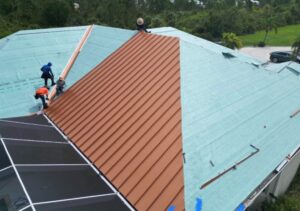
A self-adhering polymer-modified bitumen sheet applied across your entire roof deck acts as an inner shield. Insurance companies heavily favor this upgrade because it prevents the devastating interior water damage that typically follows a high-wind storm.
Roof Deck Fastening
This category grades the type and spacing of the nails holding your plywood sheets to your trusses. To maximize your discount, your roof deck should be secured with 8d ring-shank nails spaced six inches apart along the edges, which prevents wind uplift from peeling back your roof.
Roof Geometry
The actual shape of your roof plays a massive role in wind resistance. A hip roof, which slopes downward on all four sides like a pyramid, naturally channels wind over the house and receives a much higher baseline discount than a standard gable roof with flat, triangular end walls.
Shifting from Old Standards to Modern Storm Protection
Understanding how updated building techniques impact your long-term insurance costs can help you plan a smarter investment:
- Old Building Code Standards: These systems relied on smooth nails, loose felt paper, and minimal wall ties, often resulting in major insurance claims after storms.
- Modern Fortified Upgrades: This approach uses tightly spaced ring-shank fasteners, fully taped or self-adhered secondary water barriers, and reinforced metal structural straps.
- Immediate Financial Impact: Implementing these modern upgrades qualifies your home for legal wind-mitigation credits, cutting your annual premium bills by hundreds of dollars.
- Long-Term Protection Value: Beyond the premium savings, a code-compliant roof safeguards your family’s personal property and preserves our 10-year workmanship warranty.
The Homeowner’s Step-by-Step Insurance Savings Plan
If you are tired of paying exorbitant premiums and want to lower your costs safely, follow this practical checklist.
Step 1: Locate Your Current Wind Mitigation Report
Check your home insurance files to see if you have an active mitigation form on file. If your report is more than five years old, or if you have replaced your roof since it was filed, your paperwork is outdated.
Step 2: Look into Local Financial Assistance
Research programs like the My Safe Florida Home initiative. This state-backed program provides matching grant opportunities to eligible homeowners, offering up to $10,000 to help cover the cost of qualifying storm-hardening retrofits.
Step 3: Upgrade Safely During a Roof Replacement
If your home is due for a new roof, do not cut corners on the hidden components. Request a self-adhered underlayment and verified ring-shank fastening patterns to ensure the system easily passes a modern wind inspection.
Step 4: Schedule a Professional Drone and Video Evaluation
Before you contact an insurance inspector, let a professional roofer review your current system. We use advanced drone inspections to assess your roof’s condition and safely document your structural components.

Wind Mitigation and Insurance FAQs
Can a roof repair lower my insurance costs, or do I need a replacement?
A partial repair can restore your roof’s safety, but it rarely triggers a new insurance discount unless you are upgrading an entire roof section to meet current Florida Building Code standards. Full system replacements offer the most reliable path to major premium reductions.
What exactly is a hurricane straps credit in North Port?
This is an insurance discount for homeowners whose roof trusses are secured to the wall top-plates with engineered metal straps or clips. To qualify for the credit, the straps must be properly attached with the correct number of nails, preventing the roof from blowing off in a storm.
How much money can I actually save with wind mitigation roof upgrades?
Savings vary based on your specific insurance carrier and your home’s location, but many Florida homeowners see reductions on the wind portion of their policy once a passing report is submitted.
Does Leggett Roofing provide the wind mitigation certificate?
While we build your roof to exceed all wind mitigation standards, the official form must be signed by an independent certified inspector. We can provide all the necessary structural photos, documents, and engineering permits your inspector will need to verify the installation seamlessly.
Take Control of Your Home Insurance Bills
You shouldn’t have to feel completely overwhelmed by rising insurance premiums or contractor trust issues. Protecting your home investment takes honest, straightforward planning with a dependable local partner who understands exactly how to navigate Florida’s unique climate and codes.
At Leggett Roofing, we operate on a simple promise: we do what we say we’ll do. We will help you identify the precise structural upgrades your home needs to stay safe, dry, and highly insurable for decades to come.
Stop leaving money on the table. Schedule a free inspection with our experienced local team today.